
Afghan Families in Philadelphia Face Loss of Food and Health Benefits
For some Afghan families in Philadelphia, losing Medicaid means more than losing health coverage. It can disrupt career opportunities, add to family pressures and deepen uncertainty as they navigate immigration and rebuild their lives.

Sara, an Afghan mother of four living in Philadelphia, is waiting for her permanent residency while caring for her children and living apart from her husband, who remains in Afghanistan.
She says she recently lost both SNAP food assistance and Medicaid.
“The change is financially and emotionally very difficult,” she said. “Our food stamps and Medicaid have been stopped because we still have not received our green card.”
Sara's experience is part of a broader change affecting some Afghan families in Philadelphia. Federal changes to SNAP eligibility have already affected certain noncitizens, while new Medicaid restrictions are taking effect Oct. 1.
Although Afghan families may be experiencing the changes as a single crisis, public benefits like SNAP and Medicaid are determined by different eligibility rules.
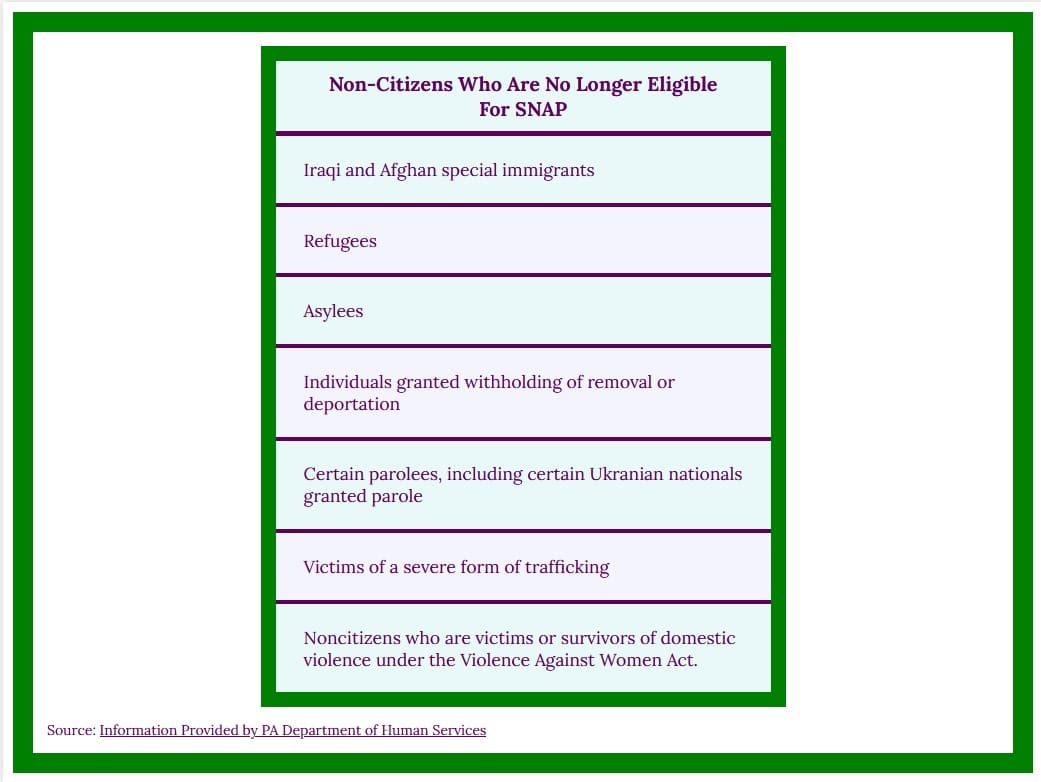
According to Pennsylvania Department of Human Services (DHS), as of Nov. 1, 2025, certain noncitizen groups—including refugees, asylees and Afghan and Iraqi special immigrants—are no longer eligible for SNAP unless they have another qualifying status, such as LPR status.
People who are currently on SNAP will stay on it until their renewal date, and they will then have their eligibility reassessed.
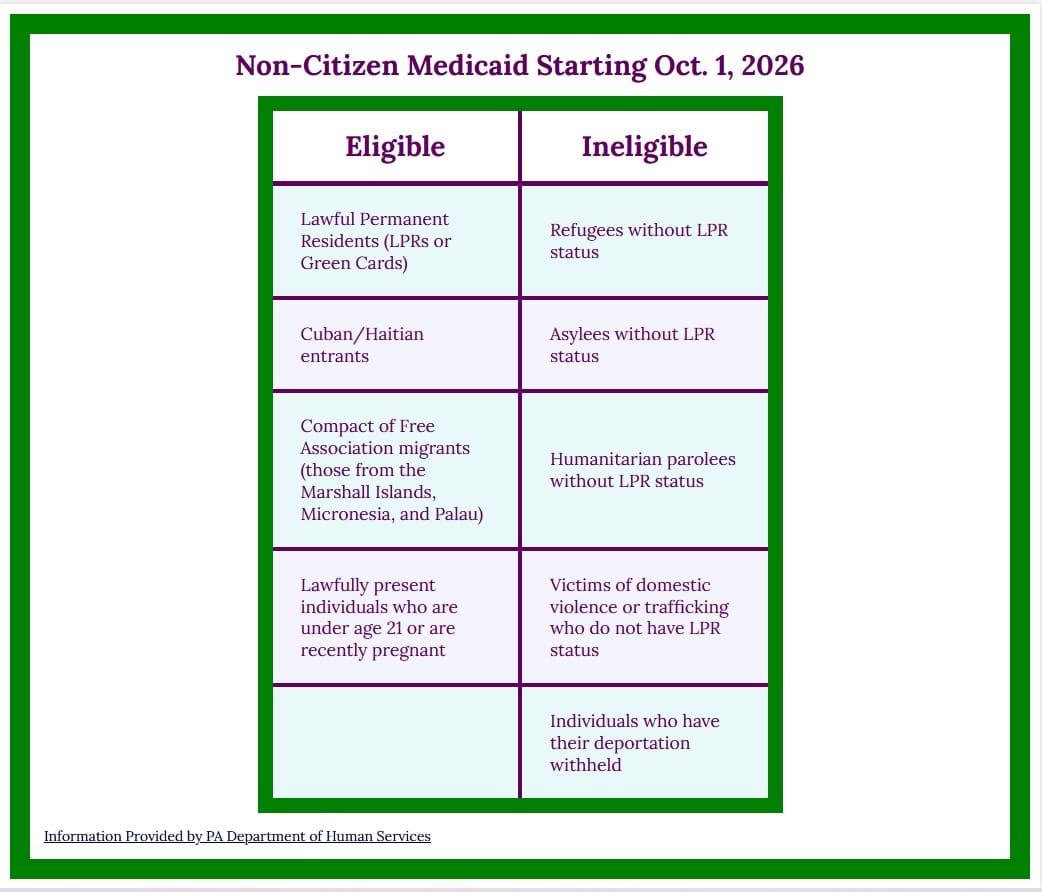
Medicaid is changing on a different timeline. Pennsylvania DHS says that beginning Oct. 1, refugees, asylees and humanitarian parolees who do not have LPRs will no longer be eligible for federally funded Medicaid under the new rules.
There are exceptions and alternative forms of coverage in circumstances, including certain coverage for children and pregnant people. Lawfully present individuals under the age of 21, those who are recently pregnant and LPRs are still eligible.
For families who are still waiting for permanent residency, looking for work, caring for children or navigating the U.S. healthcare system, the changes can have consequences that go beyond losing a monthly benefit.
Losing Medicaid, Losing a Career Opportunity
Asma, a single Afghan mother, had enrolled in Career Pathways for Healthcare, a paid training and job-placement program run by the Welcoming Center, American Training Center and Penn Medicine.
She hoped to become a medical assistant, partly inspired by her sister in Afghanistan, who has diabetes. “One of the reasons I wanted to study medical assisting was because my sister, who is currently in Afghanistan, has diabetes,” Asma said.
But the program requires participants to have health insurance for the externship portion. After Asma lost Medicaid in June because she did not yet have permanent resident status, she could no longer continue.
“After four years of living in this country, I had gradually begun to feel that this was becoming a home,” she said. “With all the sudden changes that are happening day after day, fear and anxiety have taken over my entire being, and I feel that I do not belong here or have a home here.”
Unable to afford healthcare while supporting herself and her daughter, Asma left the program. She now works full time as a teacher's assistant at her daughter's school.
Rachel Aistrop, education manager for Career Pathways, said the program is helping participants find alternative healthcare options and has increased reimbursement for some out-of-pocket medical costs.
For Asma, losing Medicaid meant more than losing insurance. It changed the career path she had been building.
For Some Families, Benefits Were a Bridge
Not every Afghan family has experienced the changes in the same way.
Maryam, has lived in the United States for five years. Her family received food assistance in the past but stopped receiving it about two years ago after their financial situation improved.
“While I was receiving the assistance, my family and I gradually improved our financial situation and eventually reached a point where we no longer needed the food assistance,” she said.
Maryam and her family were still receiving Medicaid when she was interviewed in September, but she was worried about losing it in October.
Her family is also waiting for permanent residency. One of her daughters remains in Afghanistan with her grandparents. The girl was four years old when the family was separated five years ago.
“I miss my daughter, and I am always worried about her,” Maryam said.
“Even though we still receive Medicaid, or government health insurance, I am very worried that we are going to lose it in October. And this has caused me a lot of stress.”
Language, Work and Family Responsibilities
Cathryn Miller-Wilson, executive director of HIAS Pennsylvania, said the effects are particularly difficult for clients who already face barriers to employment.
“The families where the women are here alone or caring for children and elderly parents are much harder for them, because of the language difficulty,” Miller-Wilson said.
Some Afghan families resettled by HIAS PA were able to find work relatively quickly because they had English-language skills and professional experience, she said. Others, particularly women with limited education or English skills, have had a harder time becoming financially independent.
“They really were in difficult circumstances before all this happened and as a result were dependent on the safety net benefits, and now the situation is really, really bad for them,” Miller-Wilson said.
She also said clients are confused by the changing rules and by differences between federal and state programs.
“The eligibility rules even before the current moment have always been really, really confusing,” she said.
Eligibility can depend on immigration status, income, age, pregnancy and other circumstances, and state-funded programs can differ from federally funded Medicaid.
Miller-Wilson said HIAS PA frequently refers clients to Community Legal Services and the Pennsylvania Health Law Project when they believe benefits may have been terminated incorrectly.
“They're really the places to go,” she said. “They are absolute experts.”
What Happens Next
Pennsylvania says people affected by the Medicaid changes should watch for notices from the Department of Human Services and submit requested immigration documents on time. People who lose coverage may have other options depending on their circumstances.
Philadelphia is directing residents concerned about the October changes to BenePhilly, Community Legal Services, food resources and healthcare resources.
For Afghan families, the consequences will not look the same for everyone. Some have already lost benefits. Others are waiting to see whether they will lose coverage. Some have moved off benefits as their financial circumstances improved.
But for families still navigating immigration, employment, healthcare and separation from relatives abroad, the changes add another layer of uncertainty.
“Our clients are really terrified,” Miller-Wilson said. “I can only imagine how upsetting and infuriating it is, and I don't blame them, but I hope that they spend more energy reaching out to resources.”
Where to Get Help
If you think your SNAP was ended incorrectly: Community Legal Services can help eligible Philadelphia residents with SNAP applications, denials and benefits that have been cut off or reduced. Call 215-981-3700 or visit its North Philadelphia office at 1410 W. Erie Ave. on Tuesdays and Thursdays, 9 a.m.–noon.
If you have a Medicaid problem: The Pennsylvania Health Law Project provides free legal help to people having trouble getting or keeping Medicaid through its statewide helpline at 1-800-274-3258.
For help understanding public benefits: Philadelphia's BenePhilly program provides free, one-on-one assistance with applying for benefits. The city also maintains a Welcoming Community Resource Finder, Philly Food and Meal Finder and Primary Care Finder.
For families who lose coverage, the end of Medicaid does not necessarily mean there are no places to seek medical care. Puentens de salud, Wyn Wellness center, Philadelphia FIGHT, for example, says it sees uninsured and underinsured patients and does not deny services because someone cannot pay.
Miller-Wilson also recommends that people whose benefits were terminated unexpectedly seek legal help rather than assuming they are no longer eligible.
“Community Legal Services and Pennsylvania Health Law Project … are experts,” she said.
If you need medical care after losing insurance: Philadelphia’s Primary Care Finder can help locate health centers. Philadelphia FIGHT also provides care to uninsured patients and uses a sliding fee scale.
Eligibility and services vary, so families should check with each organization before assuming they qualify.
For many Afghan families, the uncertainty is not only about losing a monthly benefit. It is about how to keep moving forward while navigating immigration paperwork, work, education, health care and family separation at the same time.
Nilofar Qayomi also contributed to this story.